



Search is changing.
For years, businesses and website owners focused mainly on SEO — Search Engine Optimization. The goal was simple: get your website on the first page of Google, attract visitors, and turn those visitors into customers.
But today, people are searching in a different way.
Instead of typing short keywords into Google and opening several websites, many users are asking complete questions and expecting a direct answer. AI-powered search, voice search, featured snippets, and conversational search have made this behaviour much more common.
This has led to the growth of AEO — Answer Engine Optimization.
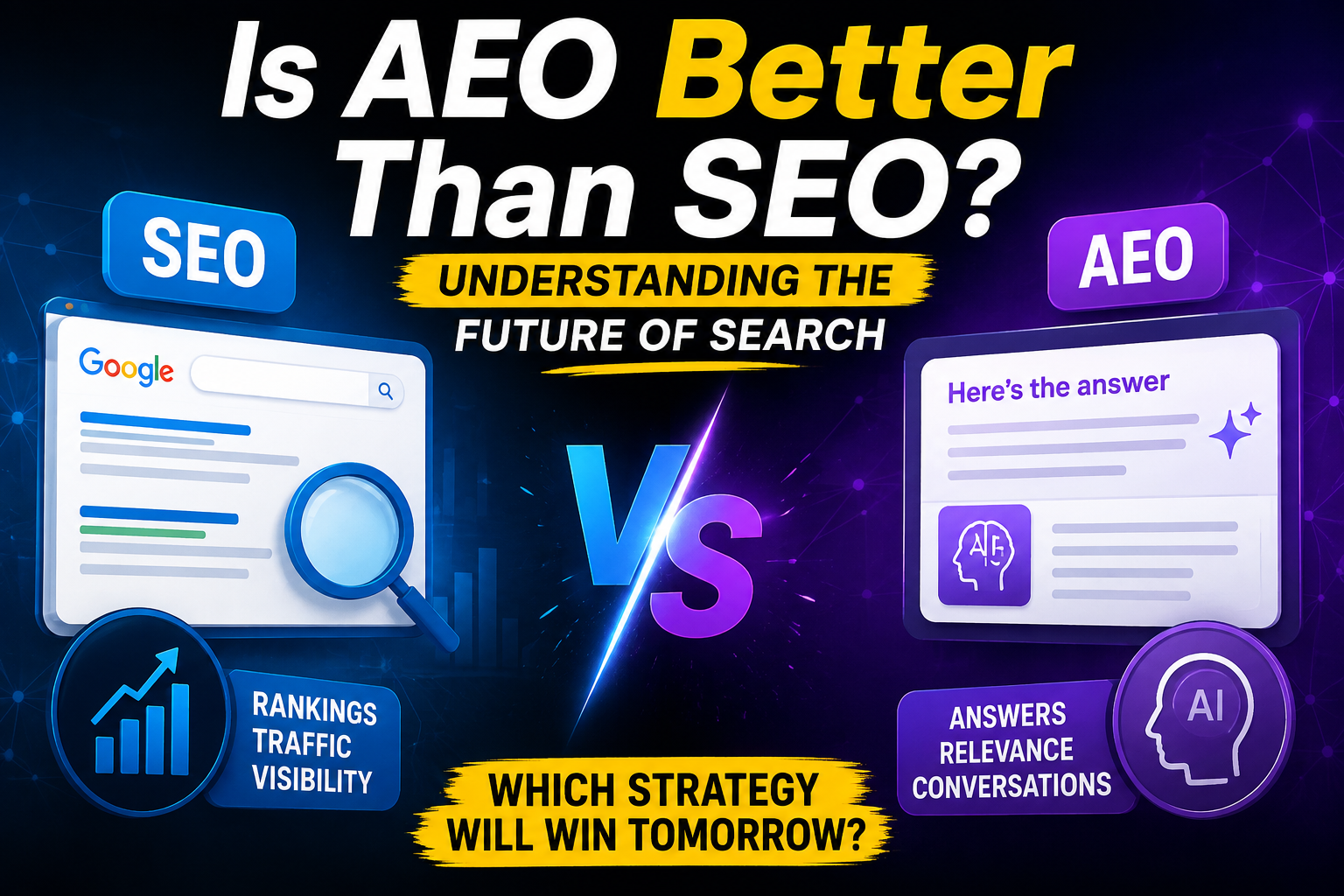
So, is AEO better than SEO?
The short answer is no — not exactly.
AEO is not replacing SEO. Instead, it is becoming an important part of modern SEO. If SEO helps your website become visible in search results, AEO focuses on making your content useful enough to become the answer.
What Is SEO?
SEO stands for Search Engine Optimization.
It is the process of improving a website so that search engines can understand its content and rank it for relevant searches.
Traditional SEO includes things such as:
– Keyword research
– On-page optimization
– Technical SEO
– Internal linking
– Website speed
– Mobile-friendliness
– Quality content
– Backlinks
– Meta titles and descriptions
– Search intent
For example, suppose someone searches for:
“Best digital marketing course in Delhi.”
An SEO-focused website would optimize its page around relevant keywords, provide useful information, build authority, and make sure the page is technically strong.
The objective is to earn visibility in search results and bring users to the website.
What Is AEO?
AEO stands for Answer Engine Optimization.
The main purpose of AEO is to structure and write content in a way that makes it easier for search engines and answer-focused platforms to understand, extract, and present useful answers.
For example, instead of only targeting:
“AEO vs SEO”
an AEO-focused article may directly answer questions such as:
or
“What is the difference between AEO and SEO?”
The content should provide a clear answer without making the reader search through several paragraphs to find it.
This is especially important as search becomes more conversational.
AEO vs SEO: What Is the Difference?
The biggest difference is the primary objective.
SEO generally focuses on improving a website’s visibility in search results.
AEO focuses more heavily on providing direct, clear and useful answers to specific questions.
Think about it this way:
SEO asks:
“How can I rank this page?”
AEO asks:
“How can I make this page the best possible answer to this question?”
Both approaches are valuable.
A page that answers questions extremely well but has poor technical SEO may struggle to get discovered.
At the same time, a technically perfect SEO page that does not actually answer the user’s question may fail to satisfy search intent.
That is why modern websites should think about both.
Is AEO Better Than SEO?
AEO can be better than traditional SEO for certain types of searches, but it cannot completely replace SEO.
Consider a user asking:
“What is GA4?”
The user probably wants a quick, understandable explanation.
A page that clearly defines GA4 in the first few sentences has a better chance of satisfying that intent than a page that takes 1,000 words before answering the question.
Now consider a search such as:
“Best digital marketing agencies in Delhi.”
Here, the user may want to compare multiple companies, services, prices, reviews and experience.
A simple answer may not be enough.
This is where traditional SEO, strong content, authority and user experience continue to matter.
So the real question should not be:
AEO or SEO?
It should be:
How can I use AEO and SEO together?
Why AEO Is Becoming More Important
The way people search is becoming more conversational.
Users increasingly ask complete questions rather than entering only two or three keywords.
For example:
Traditional search:
“SEO salary Delhi”
Conversational search:
“What salary can a fresher expect after learning SEO in Delhi?”
The second query gives much more information about the user’s intent.
Content that understands this intent can provide a much more useful response.
This is where AEO becomes valuable.
Instead of creating an article simply because a keyword has search volume, website owners need to understand the questions behind the search.
How E-E-A-T Fits Into AEO
AEO does not mean writing short answers and hoping an AI system picks them up.
Trust matters.
This is where E-E-A-T becomes important.
E-E-A-T stands for:
– Experience
– Expertise
– Authoritativeness
– Trustworthiness
A website should demonstrate why readers should trust its information.
For example, if you are writing about digital marketing careers, simply repeating information found on other websites is not enough.
You can make the article stronger by including:
– Practical examples
– Your own observations
– Real project experience
– Relevant data
– Clear explanations
– Author information
– Sources for important claims
– Updated information
– Honest limitations
Experience is particularly useful when discussing topics where practical knowledge matters.
For example, an SEO professional can explain how keyword research works in an actual project, what mistakes beginners commonly make, and what happens when a website targets the wrong search intent.
That kind of information is much more useful than simply defining SEO.
How to Make Content AEO-Friendly
There is no secret formula that guarantees that a page will appear as an answer.
However, some basic practices can make content easier to understand.
1. Answer the Main Question Early
If your article is about AEO vs SEO, don’t make readers wait until the end for the answer.
Give them a clear response near the beginning.
Then explain the reasoning in detail.
2. Use Question-Based Headings
Use headings that match the questions people naturally ask.
For example:
– What is SEO?
– What is AEO?
– Is AEO better than SEO?
– What is the difference between AEO and SEO?
– How does AEO work?
– How can businesses use AEO?
This creates a logical structure for both readers and search systems.
3. Keep Important Answers Clear
Avoid unnecessarily complicated language.
If a question can be answered in two or three sentences, answer it clearly first.
You can provide additional explanation afterward.
4. Understand Search Intent
Keywords are important, but intent is more important.
Someone searching for:
“SEO course”
may want to learn about courses.
Someone searching for:
“SEO course fees”
is probably interested in pricing.
Someone searching for:
“SEO course reviews”
may be comparing options.
The content should match what the user actually wants.
5. Build Topic Authority
One article is rarely enough to establish strong topical coverage.
If your website is about digital marketing, you could create useful supporting content around:
– SEO
– Technical SEO
– Keyword research
– On-page SEO
– Link building
– Google Search Console
– Google Analytics
– AEO
– Content marketing
– Local SEO
– Performance marketing
These articles can be connected through internal links to create a stronger content structure.
Does AEO Mean Keywords Are No Longer Important?
No.
Keywords still help search engines understand what a page is about.
The difference is that modern content should not be written simply by repeating the same keyword again and again.
For example, if your target topic is “AEO vs SEO”, you can naturally cover related concepts such as:
– Answer Engine Optimization
– Search Engine Optimization
– AI search
– search intent
– featured snippets
– conversational search
– zero-click searches
– structured content
– helpful content
The goal should be to cover the topic naturally rather than forcing keywords into every paragraph.
AEO and Featured Snippets
Featured snippets are a good example of why clear answers matter.
When a user asks a question, search engines may show a direct answer above the traditional organic results.
Content that provides a concise and well-structured answer can be easier for search systems to understand.
However, nobody can guarantee that a particular page will receive a featured snippet.
Search engines decide which content they consider useful and appropriate for a particular query.
What About AI Search?
AI-powered search is changing how information is discovered.
Instead of simply presenting a list of links, some search experiences can summarize information and provide a conversational response.
This makes content quality even more important.
If your website contains accurate, useful, clearly structured and trustworthy information, it has a better foundation for being understood and potentially referenced by modern search systems.
But businesses should not create content solely to appear in AI-generated answers.
The primary goal should still be to help the person reading the content.
The Biggest Mistake Businesses Make With AEO
One common mistake is treating AEO as a shortcut.
Some people assume that adding lots of questions to a page will automatically make it AEO-friendly.
It doesn’t work that way.
A page filled with generic questions and shallow answers is not necessarily valuable.
A better approach is to ask:
What does my audience genuinely want to know?
Then provide a useful answer based on reliable information and, where appropriate, real experience.
Quality should come before optimization.
Should You Focus on SEO or AEO?
For most websites, the best strategy is to focus on both.
SEO provides the foundation.
AEO helps your content answer specific questions more effectively.
A strong strategy could look like this:
Technical SEO → Content → Search Intent → Clear Answers → E-E-A-T → Internal Linking → Authority
This approach is more sustainable than chasing every new search trend.
Final Verdict: Is AEO Better Than SEO?
AEO is not the new version of SEO, and SEO is not becoming useless.
They solve slightly different problems.
SEO helps your website become discoverable and competitive in search.
AEO helps your content provide direct and useful answers in an increasingly conversational search environment.
The websites that are likely to perform best over the long term will not be the ones that choose one and ignore the other.
They will be the ones that understand what people are searching for, why they are searching for it, and how to give them the most useful answer.
So instead of asking:
“Is AEO better than SEO?”
a better question is:
“How can I combine SEO, AEO and E-E-A-T to create content that people actually trust and find useful?”
That is where the future of search is heading.
Quick Takeaway
SEO gets your content discovered.
AEO helps your content answer questions clearly.
E-E-A-T helps people trust what you publish.
Put all three together, and you have a much stronger foundation for a modern search strategy.