


Digital advertising has become one of the biggest growth drivers for businesses today. Whether you run an ecommerce store, local service business, coaching brand, or startup, paid advertising can help you generate traffic, leads, and sales faster than organic marketing alone.
But one question almost every business owner asks before running ads is:
Should I choose Google Ads or Meta Ads?
Both platforms are powerful, but they work very differently. One focuses on reaching people actively searching for solutions, while the other focuses on building interest and attention through visual content.
Choosing the wrong platform can waste your budget. Choosing the right one can help you scale much faster.
In this guide, we’ll compare Google Ads and Meta Ads in detail, including audience targeting, ad formats, cost, conversions, ROI, and which platform works better for different business goals.
What Are Google Ads and Meta Ads?
Google Ads
Google Ads is Google’s advertising platform where businesses can show ads across:
- Google Search
- YouTube
- Google Display Network
- Gmail
- Google Shopping
- Mobile apps
The biggest advantage of Google Ads is intent.
People using Google are already searching for something. That means they usually have a clear need or problem.
For example:
- “best immigration consultant near me”
- “buy stainless steel tumbler”
- “IELTS coaching in Brampton”
This makes Google Ads highly effective for lead generation and conversions.
Meta Ads
Meta Ads include advertising across:
- Messenger
- Audience Network
Meta Ads focus more on discovery-based marketing.
Users are not actively searching for products. Instead, businesses use visuals, videos, and creative content to grab attention while users scroll through social media.
Meta Ads work especially well for:
- Brand awareness
- Visual products
- Ecommerce
- Retargeting
- Audience engagement
The Core Difference Between Google Ads and Meta Ads
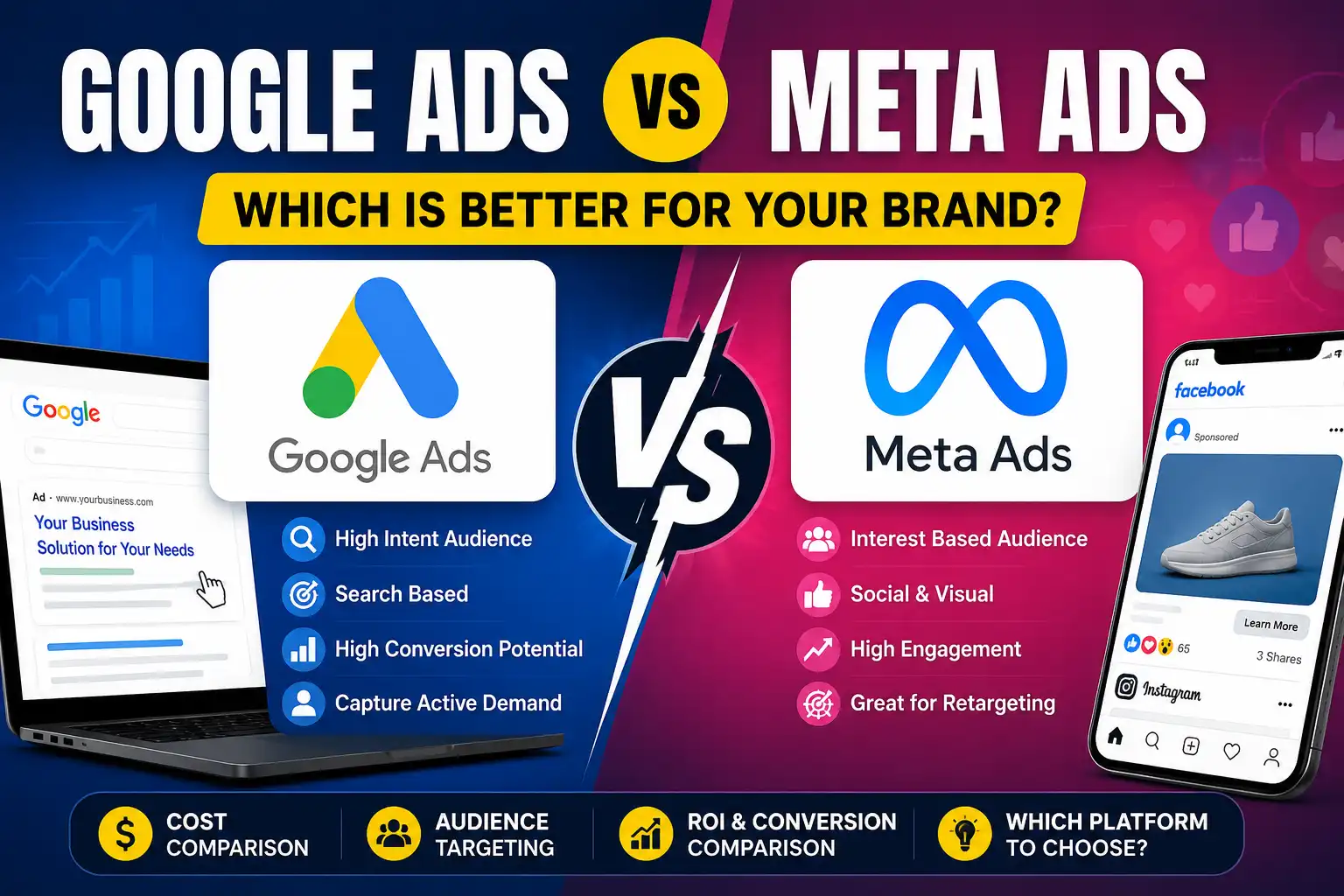
The biggest difference comes down to user intent.
| Platform | User Behavior |
|---|---|
| Google Ads | Users actively search for solutions |
| Meta Ads | Users discover products while browsing |
Google captures existing demand.
Meta creates demand.
That’s why businesses often get different results from both platforms.
Google Ads vs Meta Ads: Audience Intent
Google Ads Targets High-Intent Users
When someone searches on Google, they usually want immediate information, products, or services.
For example:
- “emergency plumber near me”
- “best CRM software”
- “apply for Canada PR”
These users are already close to making a decision.
This is why Google Ads usually generates:
- Higher-quality leads
- Better conversion intent
- Faster buying actions
Meta Ads Focus on Interest-Based Discovery
Meta platforms work differently.
People open Facebook or Instagram mainly for entertainment, networking, or content consumption.
Your ad interrupts their browsing experience.
That means your creatives, videos, and messaging become extremely important.
Meta Ads are excellent for:
- Building awareness
- Introducing new products
- Visual storytelling
- Retargeting visitors
- Scaling ecommerce brands
Ad Format Differences
Google Ads Formats
Google offers several ad types:
Search Ads
Text-based ads shown in Google search results.
Display Ads
Banner ads shown across websites and apps.
YouTube Ads
Video ads before or during YouTube videos.
Shopping Ads
Product-based ads for ecommerce stores.
Performance Max Campaigns
AI-driven campaigns that run across all Google properties.
Meta Ads Formats
Meta Ads are more visual and engagement-focused.
Popular formats include:
- Image ads
- Video ads
- Carousel ads
- Reels ads
- Story ads
- Collection ads
- Instant experience ads
Meta usually performs better when businesses use strong visuals and short-form videos.
Which Platform Gives Better ROI?
This depends heavily on your business type and goals.
Google Ads Usually Performs Better For:
- Local services
- High-intent leads
- Legal services
- Immigration consultants
- Home services
- Healthcare
- B2B companies
Because users are already searching, conversion intent is higher.
Meta Ads Usually Performs Better For:
- Fashion brands
- Beauty products
- Ecommerce stores
- Fitness brands
- Lifestyle businesses
- Coaching offers
- Personal brands
Visual products often perform very well on Instagram and Facebook.
Cost Comparison: Google Ads vs Meta Ads
One of the biggest differences businesses notice is cost.
Google Ads
Google Ads usually has:
- Higher CPC (Cost Per Click)
- More competition
- Stronger buyer intent
Popular industries like legal, finance, and insurance can have very expensive keywords.
However, higher CPC often brings better lead quality.
Meta Ads
Meta Ads often have:
- Lower CPC
- Cheaper impressions
- Better reach
But lower cost does not always mean better conversions.
A cheaper click is only valuable if it turns into revenue.
Google Ads vs Meta Ads for Lead Generation
If your goal is direct lead generation, Google Ads often performs better.
Why?
Because users already have intent.
For example:
Someone searching:
“best digital marketing agency near me”
is much more likely to convert than someone casually scrolling Instagram.
However, Meta Ads can still generate strong leads when:
- The offer is compelling
- Retargeting is used properly
- Creatives are optimized well
Google Ads vs Meta Ads for Ecommerce
Ecommerce brands often benefit from using both platforms together.
Google Ads Helps Capture Buying Intent
Shopping ads work very well for:
- Product searches
- High-purchase intent traffic
- Bottom-funnel customers
Meta Ads Helps Create Product Demand
Instagram and Facebook help brands:
- Showcase products visually
- Build emotional connection
- Retarget visitors
- Increase repeat purchases
Many successful ecommerce brands use:
- Meta for awareness
- Google for conversions
Audience Targeting Comparison
Google Ads Targeting
Google allows targeting based on:
- Keywords
- Search intent
- Location
- Device
- Demographics
- Custom audiences
- In-market audiences
Keyword targeting is the biggest strength of Google Ads.
Meta Ads Targeting
Meta focuses more on:
- Interests
- Behaviors
- Demographics
- Engagement activity
- Custom audiences
- Lookalike audiences
Meta’s retargeting capabilities are especially strong for ecommerce businesses.
Conversion Tracking and Analytics
Both platforms offer strong tracking systems.
Google Ads Tracking
Google integrates with:
- Google Analytics
- Google Tag Manager
- Google Merchant Center
This gives advertisers deep insights into:
- User behavior
- Conversion paths
- Search terms
- Purchase actions
Meta Ads Tracking
Meta uses:
- Meta Pixel
- Conversion API
- Event tracking
Businesses can track:
- Purchases
- Leads
- Add-to-cart actions
- Website visits
- Form submissions
Accurate tracking is critical for improving campaign performance on both platforms.
Which Platform Is Better for Brand Awareness?
Meta Ads usually performs better for awareness campaigns.
Why?
Because Facebook and Instagram are highly visual platforms where users spend significant time consuming content.
Meta helps brands:
- Increase visibility
- Build engagement
- Reach new audiences
- Grow social presence
Google Ads can support awareness through YouTube and Display campaigns, but Meta often creates stronger engagement at a lower cost.
Which Platform Is Better for Small Businesses?
The answer depends on the business model.
Choose Google Ads If:
- You want direct leads
- Your customers search for services
- You need fast conversions
- Your service solves urgent problems
Examples:
- Dentists
- Lawyers
- Immigration consultants
- Local repair businesses
Choose Meta Ads If:
- Your brand is visual
- You sell lifestyle products
- You want brand awareness
- You rely on content marketing
Examples:
- Clothing brands
- Fitness products
- Beauty brands
- Coaches and creators
Should Businesses Use Both Platforms Together?
In many cases, yes.
The best digital marketing strategies combine both platforms.
Here’s a simple approach:
| Funnel Stage | Best Platform |
|---|---|
| Awareness | Meta Ads |
| Interest | Meta Ads |
| Consideration | Google Ads |
| Conversion | Google Ads |
| Retargeting | Meta Ads |
This creates a stronger customer journey.
Common Mistakes Businesses Make
Running Ads Without Clear Goals
Many businesses launch campaigns without knowing whether they want:
- Leads
- Sales
- Awareness
- Traffic
Your campaign objective changes everything.
Ignoring Creative Quality
Especially on Meta Ads, weak creatives can destroy performance.
Good visuals and messaging matter a lot.
Sending Traffic to Weak Landing Pages
Even great ads fail if the landing page is poor.
Your landing page should:
- Load fast
- Be mobile-friendly
- Have a clear CTA
- Build trust quickly
Not Tracking Conversions Properly
Without proper tracking, you cannot optimize campaigns effectively.
Data is essential for scaling profitable ads.
Final Verdict: Which Platform Is Better?
There is no single winner because both platforms serve different purposes.
Google Ads is better for:
- High-intent searches
- Direct lead generation
- Fast conversions
- Service-based businesses
Meta Ads is better for:
- Brand awareness
- Visual storytelling
- Audience engagement
- Ecommerce scaling
For many businesses, the smartest strategy is using both together instead of choosing only one.
The right platform depends on:
- Your audience
- Your business model
- Your goals
- Your budget
- Your marketing funnel
When used correctly, both Google Ads and Meta Ads can become powerful growth channels for your brand.
FAQs
Is Google Ads better than Meta Ads?
Google Ads is usually better for high-intent leads, while Meta Ads is stronger for awareness and audience engagement.
Which platform is cheaper?
Meta Ads generally has a lower cost per click, but Google Ads often delivers stronger buying intent.
Which platform is best for ecommerce?
Most ecommerce brands get better results using both platforms together.
Are Meta Ads good for lead generation?
Yes, Meta Ads can generate leads effectively when paired with strong creatives and retargeting strategies.
Which platform is better for local businesses?
Google Ads is usually better for local service businesses because users actively search for nearby solutions.